Strategic Planning

The Founder's Succession Crisis: A Step-by-Step Guide to Leadership Transition Without Organizational Trauma

Founder Succession Guide

Founder succession is one of the most perilous transitions a nonprofit can face. When handled poorly, it destroys decades of good work, fractures community relationships, and leaves organizations struggling for years to recover. Yet when managed systematically, leadership transition can actually strengthen organizations by creating sustainable systems that outlast any individual leader.

The difference between trauma and transformation lies not in finding the perfect successor, but in building systematic processes that enable smooth authority transfer while preserving institutional knowledge and stakeholder trust.

The Painful Lesson That Nearly Broke an Organization

I worked at a nonprofit going through what became a three-year succession nightmare. The founder had been with the organization since its inception and genuinely wanted to transition leadership responsibly. She brought in several executive directors and other leaders to help pave the way for new leadership, demonstrating her commitment to organizational continuity.

Unfortunately, good intentions weren't enough. The process never quite worked effectively because we lacked systematic frameworks for complex transitions. Hand-offs were scattered and unclear, authority remained muddled and confusing, and new leaders consistently felt undermined despite everyone's best efforts. Additionally, there were repeated clashes about vision, values, and future planning direction that we hadn't anticipated or prepared for.

Eventually, after significant organizational pain, we had to create a detailed step-by-step plan with crystal-clear roles and responsibilities to ensure a smooth transition. It was an extremely painful process that caused some unfortunate turnover in both the organization and the board. The trauma could have been avoided with better planning, more transparent and difficult discussions early on, and systematic scenario planning exercises to anticipate and prepare for change.

The experience taught me that founder succession requires the same systematic approach we'd apply to any other complex organizational challenge.

Why Most Succession Plans Fail

Traditional succession planning often focuses exclusively on finding the right person while ignoring the systems needed to enable their success. This approach treats succession as a one-time event rather than a gradual process that requires careful orchestration over months or years.

"Founder transition is one of the most critical challenges nonprofits face, and poor planning can destroy decades of good work," warns the Bridgespan Group research team. The statistics support this concern: 75% of founder-led nonprofits struggle with succession planning, leading to significant organizational instability.

Most failures stem from ambiguity rather than incompetence. "Clear role definition and transparent communication are essential during leadership transitions. Ambiguity destroys team morale and organizational effectiveness," notes the Nonprofit Finance Fund. When everyone has different assumptions about authority, responsibility, and timeline, conflict becomes inevitable.

Leadership transition process

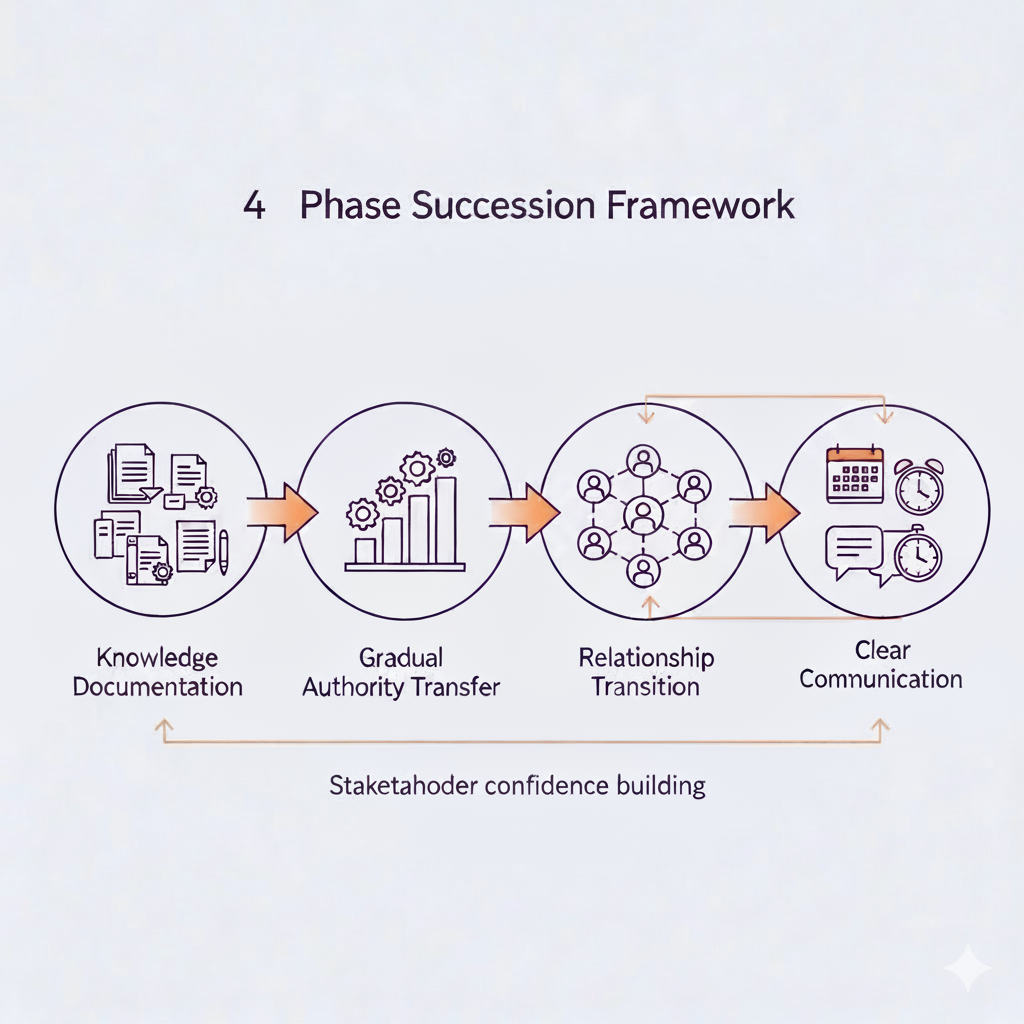
The Four-Phase Succession Framework

Phase 1: Knowledge Documentation and System Building

Begin succession planning years before transition by systematically capturing institutional knowledge that currently exists only in the founder's head. "Successful leadership transitions require founders to gradually transfer not just authority, but relationships, institutional knowledge, and community trust," explains CompassPoint Nonprofit Services findings.

Document processes, relationships, historical context, and decision-making frameworks. Create systems that enable the organization to function effectively regardless of who occupies leadership positions.

Phase 2: Gradual Authority Transfer

Design step-by-step responsibility handoffs that build new leader credibility while maintaining founder support and stakeholder confidence. Avoid the common mistake of abrupt authority transfer that leaves new leaders without institutional support or community recognition.

Start with specific programs or functions, gradually expanding responsibility as the new leader demonstrates competence and builds relationships. This approach allows for course correction and builds confidence among all stakeholders.

Phase 3: Relationship Transition and Community Introduction

"The most effective succession planning begins years before the founder is ready to leave, creating systems that don't depend on any single individual," notes BoardSource governance research. However, nonprofit leadership inherently involves personal relationships that must be carefully transferred.

Create opportunities for the new leader to build authentic relationships with donors, board members, community partners, and other stakeholders while the founder can still provide introductions and context.

Phase 4: Clear Communication and Milestone Management

Establish transparent stakeholder communication systems throughout the entire transition process. Regular updates, clear timelines, and milestone celebrations help manage anxiety and build confidence in organizational stability.

Create accountability measures with specific deadlines that keep the transition moving forward while allowing flexibility for adjustments based on what's learned during the process.

The Recovery Advantage

Organizations that plan succession well see remarkable results. Organizations with systematic transition planning maintain 90% of their staff and board members during leadership changes, according to CompassPoint research. This retention provides crucial organizational continuity and community confidence.

The contrast with traumatic transitions is stark. Nonprofits that experience traumatic leadership transitions take an average of 3 years to recover full operational effectiveness. This extended recovery period often includes lost funding, reduced program effectiveness, and damaged community relationships.

Your Succession Strategy

Whether you're a founder planning eventual transition or a board member concerned about succession readiness, systematic planning makes the difference between organizational trauma and organizational strengthening.

Ready to transform leadership transition from organizational crisis to strategic opportunity? Radiance Management's comprehensive strategic consulting services help nonprofits implement systematic succession planning and adaptive frameworks that create resilient organizations. Our Adaptable Product Framework and specialized transformation services provide the structured approaches needed for smooth leadership transitions that preserve mission impact while enabling new leadership to thrive.

Contact Radiance Management today to discover how strategic succession planning can become your organization's pathway to sustainable leadership and long-term mission success.

Sarah Rohm

About the Author

Sarah Rohm transforms decades of marketing, nonprofit leadership, executive management, and teaching experience into practical learning experiences for today's nonprofit and socially inspired enterprise leaders. Having navigated multiple industry transitions, nonprofit cycles, and scaling challenges, Sarah specializes in helping organizations and individuals adapt to changing realities while building more effective teams.

Ready to Transform Your Nonprofit's Strategy?

Radiance Management provides comprehensive strategic consulting services that help nonprofits implement data-driven approaches and build sustainable community engagement.

Get Strategic Guidance

Stay Updated with Strategic Insights

Join nonprofit leaders who receive our latest frameworks and transformation strategies

Get Strategic Updates